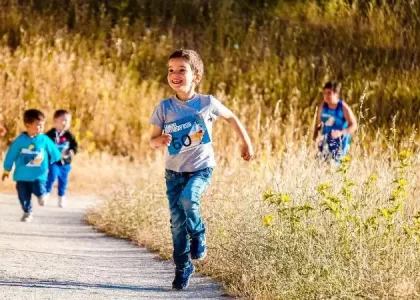
The Montessori environment is fundamentally a **Children’s Community**, designed to foster social skills, respect, and a sense of collective belonging from the earliest age. The structured, communal use of **”Welcome Welcome” and “Bye Bye” songs** serves as a daily, practical lesson in **social integration and shared ritual**, teaching children how to belong to and participate in a group.
The core of this social learning is the **shared experience**. When the guide initiates the **Welcome song**, every child in the room, regardless of their arrival time or current emotional state, is invited to participate in the same activity at the same time. This simple, communal act instantly breaks down potential barriers of isolation or individual stress. The rhythmic, synchronized movement and singing create a **group energy**—a palpable feeling of being united by a common purpose (the song). This is the earliest form of social engagement beyond parallel play, teaching children the joy and responsibility of collective participation.
Fostering Respect and Mutual Participation
The songs also model key lessons in **Grace and Courtesy**, which are fundamental to the Montessori approach. During the singing, children learn to:
- **Listen to the group:** They must follow the guide’s lead and match the rhythm and volume of their peers, practicing self-regulation and auditory attention.
- **Respect the sequence:** When names are incorporated, each child learns to wait patiently for their turn to be welcomed or to say goodbye, a practical lesson in turn-taking.
- **Acknowledge others:** The songs often involve eye contact, small gestures, or greetings directed toward peers, reinforcing the importance of actively recognizing and valuing each member of the community.
These actions are the concrete precursors to complex social interactions, teaching the child how to be a gracious participant and observer in a group setting.
In the **International Montessori** context, these rituals often transcend cultural or linguistic differences. If the song incorporates a phrase in Spanish, Mandarin, or French, every child, regardless of their home language, participates equally. This powerful, non-verbal inclusion reinforces the idea that the community is global and that diversity in language and custom is a source of enrichment. The shared song becomes a **universal language** for belonging and transition.
By making these moments of entry and exit a predictable, joyful, and communal ritual, the songs smooth the difficult transition points of the day, transforming them into opportunities for **social bonding and the construction of community**. The children feel safe, seen, and valued, strengthening their internal sense of self within the larger group structure.