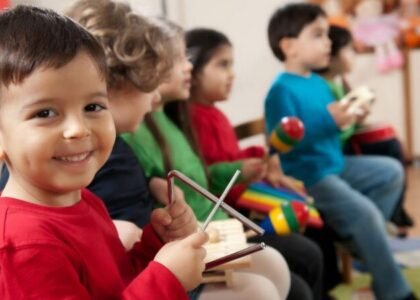
In the constellation of skills imparted by an international Montessori teacher training course, the development of ‘Grace and Courtesy’ holds a stellar position. This term encompasses not just polite social behavior, but also a refined control of movement, coordination, and an awareness of others within a shared space. Given this, the question arises: how crucially does the teaching of rhythmic movement—the foundational element of dance—support the development of this essential characteristic in future students? The link is profound and direct, establishing rhythmic movement as an indispensable tool in the Montessori teacher’s pedagogical arsenal. Dr. Maria Montessori observed that awkward, uncoordinated movement often underlies a child’s disruptive behavior or lack of concentration. Rhythmic movement and dance are, at their core, disciplines that train the body to move with precision, balance, and intentionality. By engaging in simple rhythmic exercises, future teachers internalize the principles of controlled, purposeful movement. They learn to move materials quietly, walk around a rug with awareness, and transition between activities with poise. This training is not about becoming a professional dancer; it is about cultivating a physical self-awareness that allows the teacher to become the primary, living model of ‘Grace and Courtesy’ for the children.
The teaching of ‘Grace and Courtesy’ lessons in the Montessori classroom often involves role-playing and precise physical demonstrations—how to carry a chair, how to interrupt politely, how to offer help. A teacher with rhythmic movement training can execute these demonstrations with clarity and aesthetic appeal, making the lesson more engaging and memorable for the children. The rhythm inherent in movement helps children internalize the sequence of actions, transforming a complex social behavior into a manageable, practiced routine. Furthermore, the collaborative aspect of rhythmic movement directly addresses the ‘Courtesy’ component. Group dance or movement activities require children to be acutely aware of their peers’ space, rhythm, and position. They learn to adjust their own movements to avoid collision and maintain group harmony. This physical negotiation translates directly into social courtesy—understanding personal space, respecting others’ work cycles, and moving carefully within the community. The international dimension of the training course enhances this benefit. Trainees from diverse movement traditions learn to respect different non-verbal customs and physical forms of expression. This broader understanding allows them to be more sensitive to cultural variations in ‘Grace and Courtesy’ among their future international students, making the environment truly inclusive and respectful of all backgrounds.
Rhythm as a Foundation for Concentration and Intellectual Order
Beyond the social and physical benefits, rhythmic movement training also supports the child’s intellectual development, which is fundamentally linked to ‘Grace and Courtesy.’ The ability to sustain focus—a key part of ‘grace’—is supported by an internal sense of order. Rhythm, whether in music or movement, is structured order. Through rhythmic exercises, the child develops an internal metronome and a better sense of sequence and pattern. This internal order is then applied to the intellectual tasks of the classroom. For example, a child with a developed sense of rhythm finds it easier to grasp the sequential nature of reading (phonetics) or the patterning of mathematics. The teacher, trained in using rhythmic movement, can leverage this connection, integrating clapping, foot-tapping, or simple dances to reinforce academic concepts, effectively using the body as a pathway to the mind. The teaching of rhythmic movement is therefore not a tangential activity but a crucial, cross-curricular support for the development of the ‘normalised’ child—a child who is self-controlled, focused, and harmonious in their actions. It equips the international Montessori teacher with the practical skills to model and guide children towards the profound physical and social refinement that ‘Grace and Courtesy’ represents, ultimately fulfilling the vision of an education that nurtures the whole, well-integrated human being.