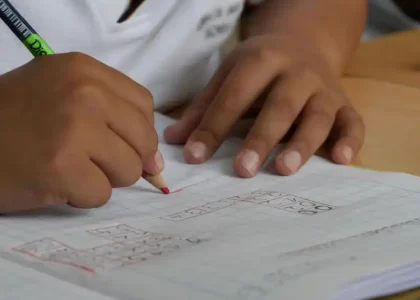

The construction of the **writing schema** in the First Plane relies on the seamless mapping of phonetic sounds (auditory input) to symbols (visual/kinesthetic input), exemplified by the **Moveable Alphabet**. In a **bilingual Montessori program** for children of **expatriate families**, the introduction of two distinct phonetic inventories—especially those with overlapping but subtly different sounds—creates a risk of **auditory and neurological confusion**. The subtle phonetic elements of the two languages can interfere, leading to a fractured rather than unified construction of the writing mechanism. The challenge of **international montessori** is to make the distinction an asset, not a detriment.
The Explicit Isolation of Phonetic Contrasts
To ensure a seamless and efficient construction of the writing schema, the language curriculum must move beyond standard isolated sound work to engage in **Explicit Isolation of Phonetic Contrasts**. The directress must use the **Phonetic Introductions** apparatus (such as sandpaper letters) to explicitly contrast the phonemes that are similar but subtly different between the two languages (e.g., the subtle variations of the ‘R’ sound in English versus many European languages). This intervention involves a **Three Period Lesson** for *minimal pairs* across the two languages. The child is not simply learning the sounds, but learning to neurologically *filter* and *categorize* the nuanced differences, thereby preventing confusion and building a more robust, compartmentalized auditory processing system. This is the application of the **Sense of Order** to the abstract realm of language sounds.
The Writing Schema as a Universal Tool
For children attending **Cultural exchange Montessori camps**, the writing work should culminate in the creation of **trans-linguistic communication tools**. This could involve writing a short, symbolic story where key nouns are written in one language and adjectives in the other, forcing the child to recognize that the *function* of the parts of speech is universally constant, regardless of the phonetic envelope. This advanced integration demonstrates the ultimate goal of **international education**: to view the writing schema not as a tool for one culture, but as a universally applicable mechanism for recording and transmitting human thought. This purposeful work overcomes the potential phonetic confusion, validating the child’s dual linguistic reality as a powerful, integrated skill set for the world of **expatriate families**.