
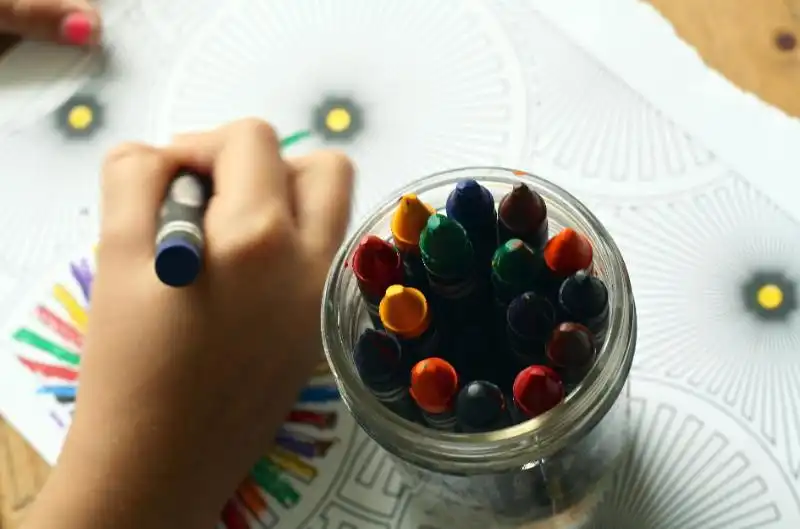
The **glass painting** exercise in the International Montessori Toddler Community (often starting around 2.5 years) is a deceptively simple activity that carries immense developmental weight. It is not merely an art project; it is a meticulously designed practical life exercise intended to refine two critical skills for future academic success: **visual discrimination** and **fine motor control**, specifically the control of the hand for writing.
Refining the Hand and Eye for Future Work
The process involves placing a simple, often geometric, black-lined drawing beneath a piece of clear glass. The child is then given small amounts of paint and a fine brush, with the task of filling the spaces within the black lines without going over. This work demands an intense level of **visual concentration** and **precision**. The child must carefully observe the boundaries of the lines—an act of visual discrimination—and then precisely guide their brush to stop the color at that boundary—an act of controlled fine motor skill.
The importance of this task lies in its contribution to **pre-writing skills**. The coordination of the small muscles of the hand and wrist, the development of the pincer grip, and the ability to control a tool (the brush) with lightness and accuracy are all prerequisites for holding a pencil and forming letters. Glass painting acts as a bridge between the gross motor movements of earlier practical life work and the abstract precision required for written language. It is a concrete way for the child to practice the deliberate control necessary for legible handwriting.
Furthermore, the smooth surface of the glass and the viscosity of the paint require the child to manage resistance and pressure, offering a rich **sensorial experience** that aids concentration. If the child rushes or pushes too hard, the paint smears or runs over the line. The material itself provides the **control of error**, teaching the child the necessity of precision and patience. The beauty of the final, filled-in design is the intrinsic reward, reinforcing the satisfaction of careful, successful work.
In the International Montessori view, the value of glass painting is not in the creation of a masterpiece, but in the self-construction achieved through the process. It systematically develops the child’s visual perception and the dexterity of their hand, ensuring they are psychologically and physically prepared for the next stage of intellectual exploration, making it a key component of the early childhood curriculum.