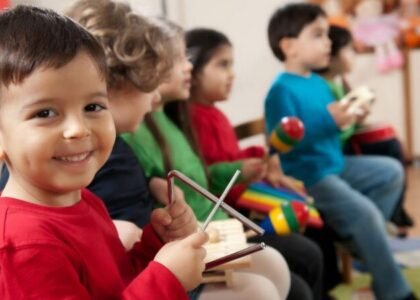
The **International Montessori** classroom, often called a “Children’s Community,” places immense value on **social development** and the child’s integration into the group. The incorporation of simple **international dance steps** is a superb, non-verbal way to foster early **social awareness, cooperation, and a strong sense of community** among infants and toddlers.
Dance, particularly group folk dances or rhythmic games, is inherently a communal activity. When children participate, they are not only focusing on their own movements but also implicitly learning to move **in harmony with others**. They observe the guide and their peers, adjusting their speed and position to stay aligned. This observational learning and cooperative movement is a critical step in developing **empathy and social coordination**—the ability to be aware of and adjust to the presence of others in a shared space.
Non-Verbal Communication and Cultural Appreciation
For toddlers, who are just beginning to develop robust verbal communication, dance serves as a powerful medium for **non-verbal communication and emotional expression**. Moving together to music helps to release energy, reduce stress, and synchronize the group’s mood, leading to a calmer, more cohesive classroom atmosphere. The shared experience creates an immediate bond and a feeling of belonging.
Furthermore, using simple dances from around the world—a Ghanaian circle dance, a Japanese children’s ring game, or a basic European line dance—instills an early, concrete appreciation for **cultural diversity**. The toddlers experience the music and movement traditions of different places, subtly embedding the international ethos of the Montessori philosophy. This hands-on cultural immersion promotes the idea that differences in expression are beautiful and enriching, nurturing the child’s identity as a citizen of the world.
The structure required to perform these steps together promotes **turn-taking, respect for personal space, and patience**. The children learn to wait for the next cue in the music or the next instruction. This collective focus transforms the group from a collection of individuals into a supportive working unit. Thus, international dance steps are a vital tool in the International Montessori Toddler Community, building social grace and a peaceful, cooperative spirit through joyful movement.